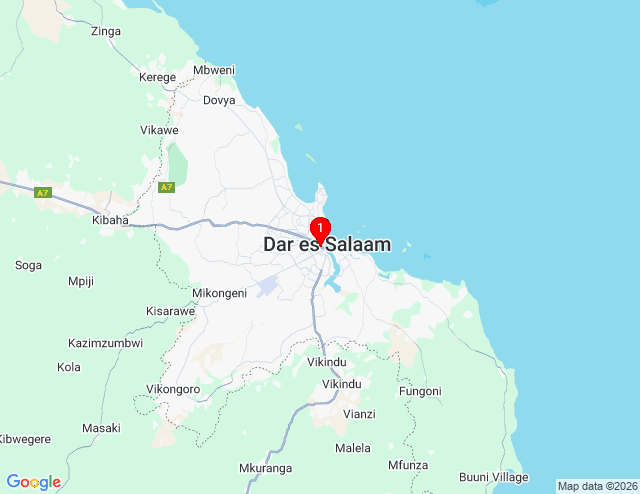
Dar es Salaam is certainly not at the top of the list of places to see for most visitors to Tanzania. It's often a necessary stop on their way to Zanzibar, the northern safari circuit, or home. That being said, Dar has its charm. Walks around the city center are a great way to get a feel for the culture and Kariakoo market can be an interesting place for the more adventurous. It can also be a good base for visiting some of the nearby sites such as Bagamoyo, Bongoyo and Mbudja Islands, as well as to learn to scuba dive or go deep sea fishing. For those looking for something more humanitarian, most international organizations are based in Dar and may be a good starting point if you wish to volunteer.
Dar es Salaam’s history is closely tied to the rise and fall of coastal trade along the Indian Ocean. Originally a small fishing settlement known as Mzizima, the area became significant in the mid-19th century when Sultan Majid bin Said of Zanzibar founded the city in 1862 and named it Dar es Salaam, meaning “Haven of Peace.” Its natural harbor made it an ideal trading port, attracting merchants from Arabia, India, and the African interior.
During the late 1800s, Dar es Salaam became the administrative and commercial center of German East Africa. The Germans developed the port, built railways, and introduced colonial architecture, traces of which can still be seen today in areas like the city center. After Germany’s defeat in World War I, the city came under British rule, further expanding its infrastructure and role as a regional hub.
Following Tanzania’s independence in 1961, Dar es Salaam emerged as the heart of political, cultural, and economic life. Although the official capital later moved to Dodoma, Dar es Salaam has remained the country’s largest and most influential city. Today, travelers can explore its layered history through historic buildings, museums, old mosques, and markets that reflect centuries of African, Arab, Indian, and European influence, making the city a living timeline of East Africa’s past.